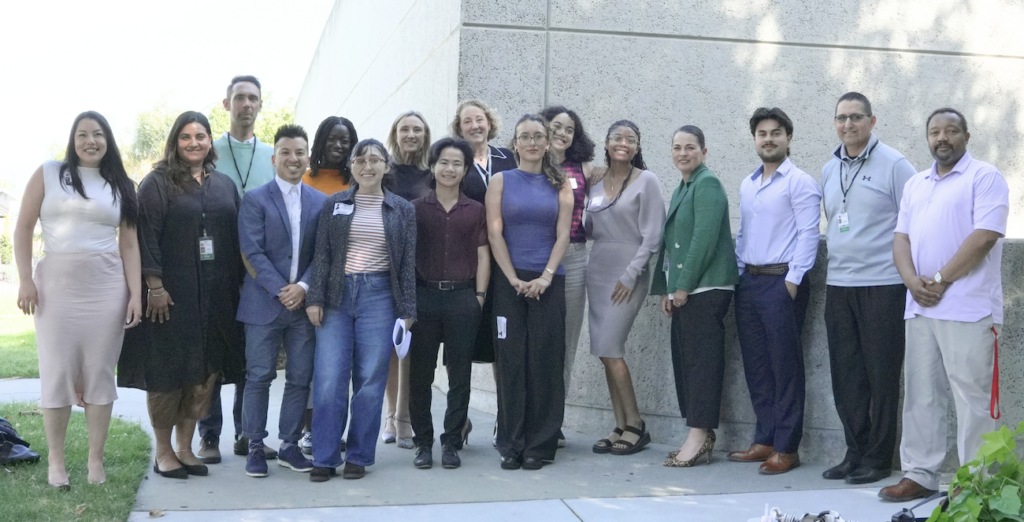
Roses Talk: Elevating At-Promise Student Voices in San José Unified is a Stanford Center for Racial Justice Law and Policy Lab (LAW 809X/EDUC 309X) co-led by Dr. Subini Annamma and Hoang Pham that seeks to directly address persistent disparities in education by centering “at-promise” student voices in education policy and practice. In the course, Stanford students conduct interviews and focus groups with the most marginalized students at Gunderson High School, a Title I school in San José Unified School District (SJUSD). Using this data, students will develop policy recommendations that inform school and district decision making, particularly on how to engage and improve outcomes for at-promise students across the district. As part of their coursework, students author a series of independent blog posts that offer insight into their experiences. These reflections not only document their learning but also contribute to an ongoing dialogue about education in the U.S., particularly by amplifying the voices of the young people they work with.
Turning Student Voices into Meaningful Change | Zoe Edelman
Our student partners in this research project are not usually sought out for their perspective, despite it providing significant insight into what changes might be needed to improve their educational outcomes. Because at-promise students are so rarely asked about their experiences and what needs to change, it is essential that our research team’s policy recommendations remain faithful to student voices and prompt meaningful action. This is nonetheless a complex task, with no clear guidebook about how to reach impactful outcomes. Traditional approaches to education research—precisely ones that have failed to center the reflections of marginalized students—are unlikely to apply.
The Roses Talk Project’s research process has introduced me to a completely new set of rigorous qualitative research tools, centrally the “composite character story.” At first, when I heard we would be creating amalgamated characters who reflected the experiences and challenges iterated by the wonderful students we interviewed at Gunderson, I was dubious. How would this medium serve to meaningfully capture student voices? Who would be moved by data in this form, accepting its words—the students’ words—as important and a call to action? Where did this place me in the research process, as I remained faithful to the students’ words while tasked with creating my composite character, “Tati?”
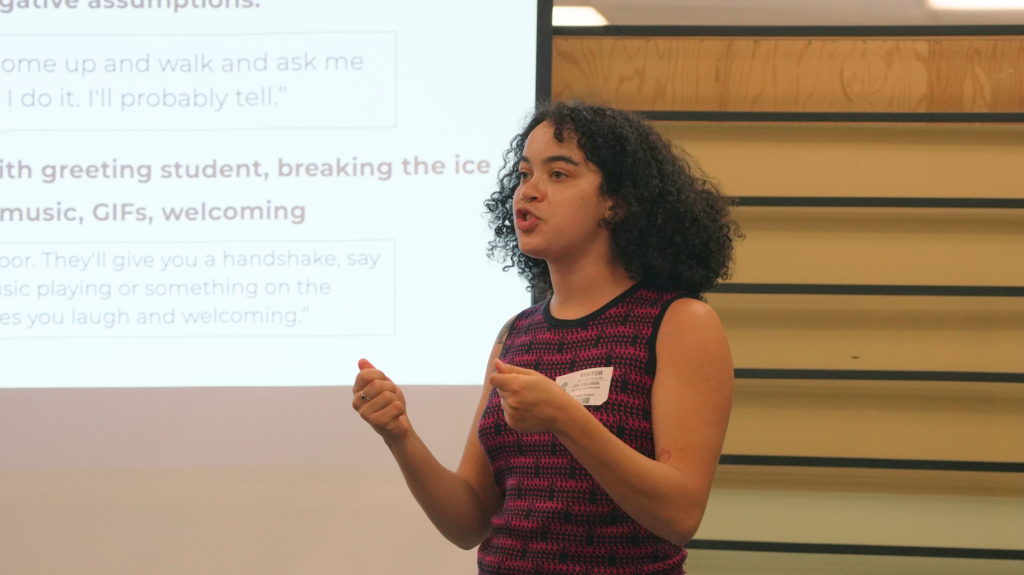
As I worked through Tati’s narrative, she gradually became a mirror reflection of the student voices I heard, to the point where I began imagining her traversing the halls of Gunderson or whispering with friends between classes. She is not a true Gunderson freshman, but her experiences told in the composite story are built off of real students. As a Black female student, Andrea, one of my research teammates, and I knew Tati’s reality would neither per se be applicable to all the students we spoke to nor the majority demographics at Gunderson. Yet she lives the experiences, emotions, and outlook shared by some of her Gunderson “classmates,” some Black girls, some not. And what we were able to learn from Tati, from the students we spoke with, translated into recommendations that I hope can improve students’ experiences for the better. I am grateful to them for their candid reflections.
Despite my faith in our conclusions based on weeks of data analysis, I was stuck thinking about how our research would be received going into a presentation of preliminary findings with Gunderson and SJUSD leadership. I was not sure how the composite character analysis would be received by them. Would they be moved and inspired by these stories and the resulting recommendations? Would they be skeptical of student voices, or at least the way we reflected them in our composite stories? Would our recommendations seem unrealistic?
Ultimately, the presentation went well and I appreciated the chance to get feedback from experienced educators who would be reviewing and hopefully incorporating our feedback. Most essentially, the following week we conducted member checking focus groups to follow-up on our preliminary findings, making sure that our recommendations were actually aligned with what students wanted to change. It is uncertain what will be done with our final report, and whether our suggested interventions will be implemented to the intended effect. Indeed, the outsider status we hold as Stanford students conducting this research means that we will not be around to see the eventual result of this project. These uncertainties make me wonder: How will we know if our interpretations of the students’ words—even when repeatedly distilled, clarified, and specified—will be meaningfully implemented for the betterment of all students?
Building Trust—with Students and Myself | Andrea Akinola
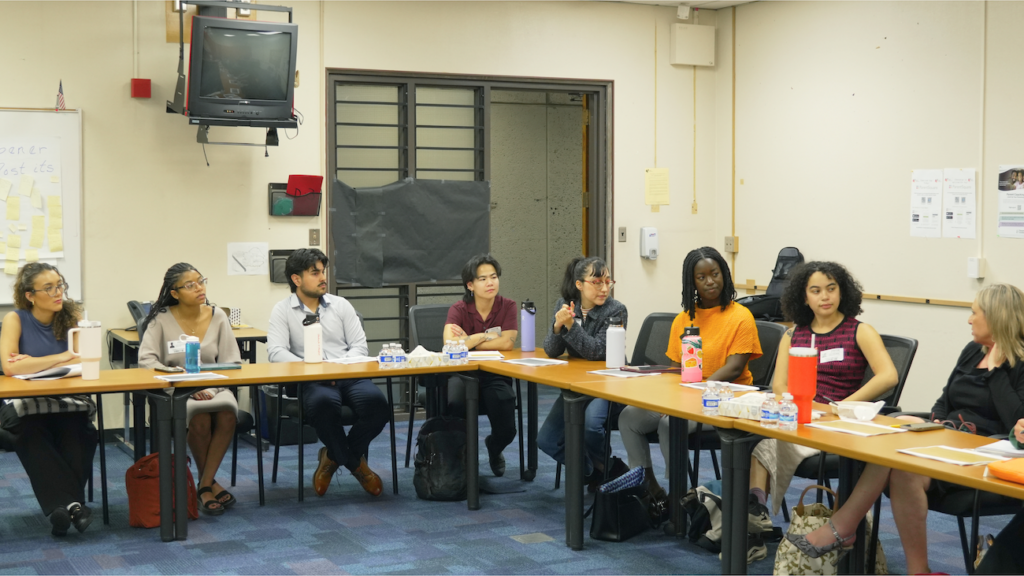
At the end of our presentation to SJUSD and Gunderson leadership, we opened up the discussion for questions and feedback. One district leader’s question especially stuck with me: “How did you get the students to trust you?” My teammates and I shared the various things we did to create a space where students felt comfortable opening up to us. But long after the presentation was over, I kept thinking about this leader’s question.
For class the following week, we read Kakali Bhattacharya’s article, “Consenting to the Consent Form: What Are the Fixed and Fluid Understandings Between the Researcher and the Researched?” (2007). Reflecting on her own experience with her research participant, Bhattacharya highlighted the importance of trusting researcher-participant relationships, but also pondered, “Why does Neerada trust me? What does that mean? I don’t even trust myself.” Bhattacharya’s questions summed up my own reflections: Did I trust that I was accurately encapsulating our students’ voices?
As we completed data analysis, the idea of “trust” continued to animate our work. How could we ensure that our data was trustworthy? We had listened to our students’ interviews and pulled out themes and recommendations based on what we heard, but throughout the process, I found myself wishing I could ask my students follow-up questions. Was this what you meant when you said that? Does this theme we created accurately sum up your experience? I was grateful we could ask these questions when we returned to Gunderson to lead member checking focus groups.
Dr. Subini Annamma, one of our co-instructors, suggested we use a photo-elicitation technique in one of our member checking activities to get our students to identify key themes about their education journey. In our focus groups, we gave students small polaroid cameras and had them lead us around campus, stopping to take photos of places or things that felt salient to their story. Initially, I wasn’t sure how successful the activity would be. If someone had asked me to take a photo of a theme, I wouldn’t even know where to start. But students made the most of the open-ended nature of the activity. As they led me through the Gunderson campus and snapped photos of a bench, a little nook in the library, and the open football field, I caught glimpses of school through their eyes. It was powerful not only to hear them explain what these spots represented to each of them, but also to watch them interact with their friends in the hallways and show off things they were proud of. I was grateful for the additional context that this experience provided me, and that they once again were willing to trust me with their stories.
After the picture walk, we made it back inside the classroom and reviewed the recommendations our research team developed. The students had an opportunity to vote on the recommendations they agreed with most, but also redirected us to things we had potentially missed, including providing additional recommendations that they originally didn’t share but wanted to include in our final report.
At the end of the focus group, I felt like there was not enough time to ask every question and dig into every response, but I’m slowly getting more comfortable with the fact that you can’t always tie neat bows around your research question. Ensuring our data is trustworthy will be an iterative process and likely one that will never feel complete. However, I celebrated the fact that I left the focus group session feeling more confident in the accuracy of our data, our ability to make change at the school, and the connections I’m building with these incredible students.
Zoe Edelman (BA ’25) (she/her) is a senior from Washington, D.C. interested in Black history and education. At Stanford, she studies History with a minor in Political Science, and aims to use her academic background to contribute to radically supportive and de-colonial educational experiences for students. Over the past six months, Zoe has worked at two public charter schools—in New York City and D.C.—assisting students in English and math classes. She will be teaching full time in her hometown of D.C. beginning in fall 2025. On campus, Zoe has participated in journalism, student divestment organizing, and various history research projects. In her free time, she enjoys walking/running, hanging out with her dogs Jack and Kona, and drinking an iced coffee.
Andrea Akinola (JD ‘27) (she/her) is a 1L at Stanford Law School from Irvine, California. Her interests include civil rights law and education equity. Before coming to law school, Andrea was an English Teaching Assistant in Las Palmas de Gran Canaria, Spain where she worked with her students and her community on a research project on Canarian history, identity, and belonging. Andrea graduated cum laude from Columbia University with a Bachelor of Arts in Political Science and a minor in Education Studies. While at Columbia, Andrea was a Diversity, Equity, and Inclusion facilitator at the Office of Multicultural Affairs, the Vice President of Columbia Women in Law and Politics, and a member of the Holder Initiative for Civil and Political Rights. In her free time, Andrea enjoys working out, baking gluten-free desserts, and watching reality TV.
Photo Credit: Bhabna Banerjee
Follow the Stanford Center for Racial Justice on LinkedIn and Instagram and subscribe to our newsletter.