Welcome to The Brief, our newsletter bringing you focused insights on race, law, policy, and technology from the Stanford Center for Racial Justice.
Rethinking Education Policy Through On-the-Ground Partnerships
Persistent disparities in K–12 education are well documented, but the students who face the greatest educational challenges—those whose experiences most clearly reveal where systems are falling short—are routinely excluded from conversations about how schools can better support their success. Their knowledge of how policies actually operate on the ground remains, in our view, one of the most underutilized resources in education reform.
The Roses Talk Project, our Law and Policy Lab in partnership with the San José Unified School District, is designed to address that gap. Through interviews and focus groups with students at Gunderson High School, the project translates lived expertise into actionable, evidence-based recommendations for school and district leaders—identifying both where existing resources and supports are falling short and where new ones are needed.
In our new report, we outline an ambitious yet feasible set of recommendations across four areas: post-secondary support; teaching and learning; discipline, relationships, and school climate; and facilities and athletics. Together, they reflect a central premise of the project: that while many factors affecting young people lie outside the control of schools, district and school leaders retain significant power to redesign systems to meet the needs of historically underserved students—and that community-engaged scholarship can help bridge research, policy, and practice in service of that work.
Read the Report.
Download the Executive Summary.
Watch the Project Video.
Upcoming Events
Apr 30 [TODAY] A Conversation with SCRJ’s Bremond Fellows Brionna Bolaños, JD ‘27, and Dayle Chung, JD ‘27 on the Constitutionality of Federalizing the National Guard and the Implications of the California Racial Justice Act from 5:00 – 6:00 pm at Stanford Law School. Register here.
May 4 The Future of the Voting Rights Act: A Fireside Chat with Professor Pam Karlan and Michael Li (Brennan Center) on the Supreme Court’s ruling in Louisiana v. Callais from 1:00 – 2:00 pm at Stanford Law School. Registration information to come.
May 8 Application deadline for rising Stanford Law School 2Ls and 3Ls to apply for the Center’s 2026-2027 Harry Bremond Wilson Sonsini Foundation Student Fellowship. Learn more about working at the Center here and apply here.
FACULTY DIRECTOR’S CORNER
Professor Ralph Richard Banks: Antidiscrimination Law Meets AI
In April, Elon Musk’s xAI sued to block Colorado’s first-in-the-nation AI antidiscrimination law, and the Trump Justice Department has since joined the lawsuit, arguing the law forces developers to incorporate “discriminatory ideology.”
These tensions, and others like them, were at the center of Antidiscrimination Law x AI, a landmark convening the Racial Justice Center organized in March at Stanford Law School. The invitation-only gathering brought together a wide array of experts, from legal academics and policy advocates to computer scientists and tech industry representatives. The gathering represented a first step in recognition of the need to rethink the structure of antidiscrimination law as technology advances.
American antidiscrimination law has long rested on three pillars: intent, formal classification, and impact. In recent years, the federal courts and executive branch have accorded primacy to the intent and formal classification standards, while minimizing the relevance of impact. Advances in artificial intelligence promise to transform the operation of public and private institutions alike, from law enforcement agencies and governmental programs to employers, schools, housing providers, medical practitioners and more. Such transformations—at once technological, economic and social—will call for a rethinking of legal norms and frameworks.
The evolution of the law is in tension with technological advances that will render discriminatory intent and formal classification increasingly inapplicable. The idea of impact will move to the fore, and will require ever more nuanced and domain-specific formulations. Indeed, AI may unsettle longstanding beliefs about the particular groups or characteristics with respect to which antidiscrimination law should operate.
In order for this process to best serve societal interests, interdisciplinary expertise and cross-sector collaboration will be essential. Analyses need to consider the potential and limits of current doctrinal frameworks, the possibility of new legislation or regulations, and the role of industry norms and best practices. While it is difficult to imagine the precise contours of the antidiscrimination regime of the future, what seems clear is that the regulatory structures of the past will be increasingly ill-fitted to our AI future.
From the Stanford Center for Racial Justice
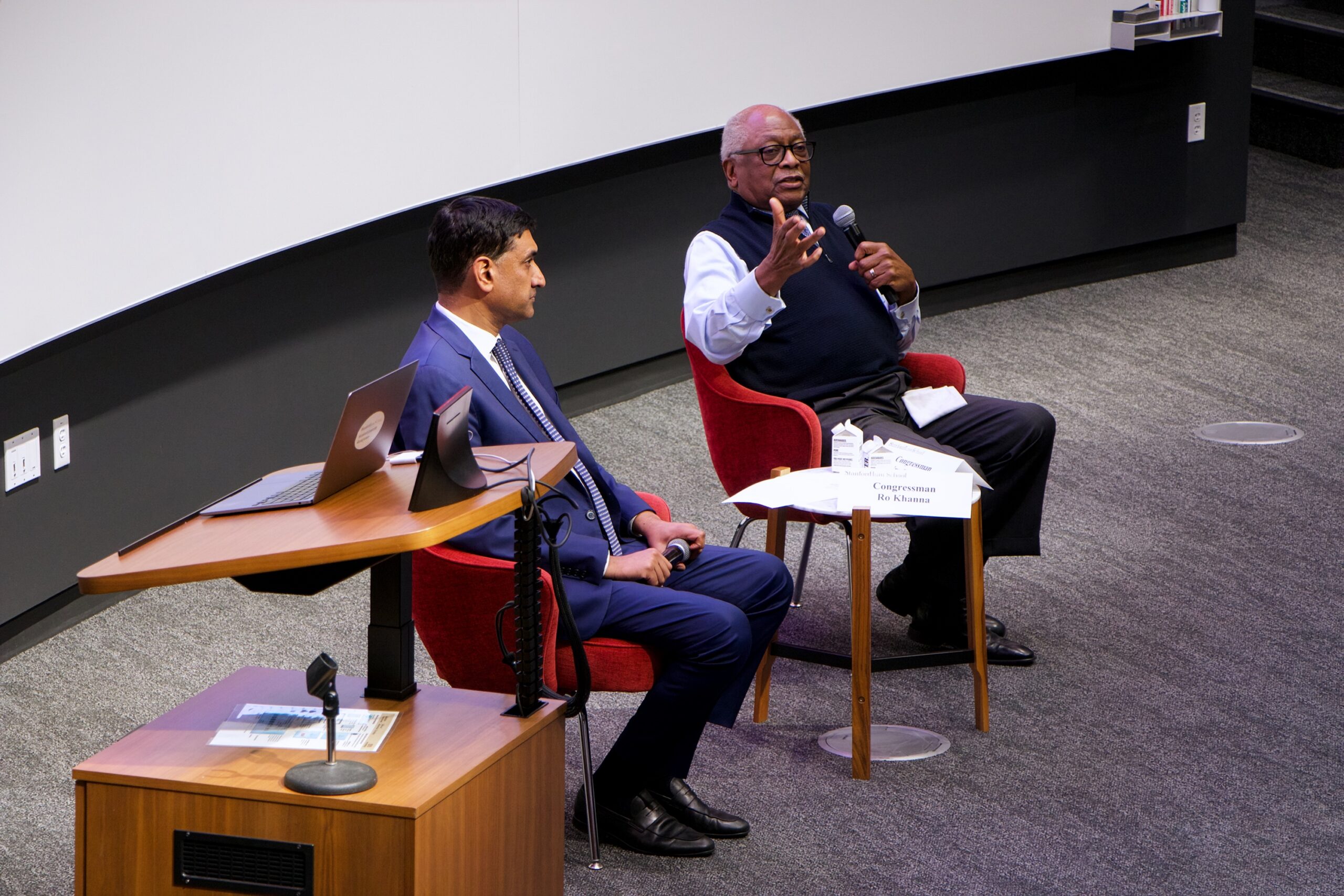
The Center hosted Congressman Jim Clyburn and Congressman Ro Khanna for a wide-ranging discussion on Rep. Clyburn’s new book, The First Eight, Black political history, and the practice of civil discourse across deep political divides. Nkemjika Emenike, JD ‘28, and Reva Kale, JD ‘28 reflected on the event.
The Center, together with Harvard Law School’s Charles Hamilton Houston Institute and GW Law’s Multiracial Democracy Project, hosted a two-day convening at Stanford Law School that brought together legal scholars, civil rights advocates, technologists, and policymakers to grapple with how antidiscrimination law should respond as AI increasingly shapes consequential decisions. Professors Rick Banks, Nathaniel Persily, and Julian Nyarko shared their thoughts on the conversations.
ON THE RECORD
“AI governance is increasingly being understood, correctly, as something that requires technical expertise, legal judgment, institutional knowledge, and attention to civil rights all at once. That is especially true when these systems are used in areas like employment, housing, education, public safety, and criminal justice, where the stakes are high and the harms may be difficult to detect or articulate in conventional legal terms.”
Ralph Richard Banks Faculty Director, Stanford Center for Racial Justice
On a key theme from the Center’s recent Antidiscrimination Law x AI Conference.

Here’s what else we’re following.
New York City’s first racial equity plan toned down to avoid a fight with Trump
Mayor Zohran Mamdani released New York City’s long-delayed, voter-mandated Citywide Racial Equity Plan, but New York Times reporting–citing people familiar with the drafts–found that references to “diversity, equity, and inclusion” were deliberately softened to conform to language upheld in the courts and avoid a confrontation with the Trump administration. New York Times
AI gives Black students more praise, less constructive criticism, study finds
A Stanford study submitting 600 identical middle school essays to four AI models found that feedback shifted based on the student’s described identity—essays attributed to Black students received more encouragement and praise, those labeled as Hispanic or English learners triggered more grammar corrections, and only essays attributed to white students consistently received the kind of substantive critique on argument and evidence that helps writers improve. The Hechinger Report
Lawsuit challenges race-based eligibility for California’s Black Infant Health program
A Pasadena mother represented by the Pacific Legal Foundation, a law firm that litigates conservative causes, filed a federal class-action lawsuit alleging that the state-funded Black Infant Health program—which provides prenatal and postpartum support to Black mothers to address persistent racial disparities in infant mortality—violates the Equal Protection Clause and Title VI by limiting eligibility on the basis of race. Pasadena Now

Source link