U.S. Supreme Court
As always, this time of year is filled with major decisions from the U.S. Supreme Court. Some of the most important cases of the term already have been decided, including Learning Resources Inc. v. Trump, which invalidated President Donald Trump’s tariffs; and Louisiana v. Callais, which significantly lessened protections under Section 2 of the Voting Rights Act of 1965. But many likely blockbuster decisions remain.
Challenges to President Trump’s actions
Not surprisingly, the October 2025 term might be most remembered for the many rulings on presidential power. In Trump v. Barbara, the court will decide the constitutionality of President Trump’s executive order greatly limiting birthright citizenship. Section 1 of the 14th Amendment states that “All persons born or naturalized in the United States, and subject to the jurisdiction thereof, are citizens of the United States and of the state wherein they reside.” In United States v. Wong Kim Ark (1898), the court held that this means that everyone born in the United States is a citizen regardless of the citizenship status of their parents, with the limited exceptions of babies born to soldiers of an invading army or foreign diplomats. President Trump’s executive order would grant citizenship only to children born to citizens or to those who are lawful long-term residents; babies born to undocumented individuals or those here on visas would not be citizens. Every lower federal court found the executive order to be unconstitutional, and the Supreme Court held oral arguments April 1.
There are two major cases about Congress’ power to limit the president’s ability to fire executive branch officials. In Humphrey’s Executor v. United States (1935), the court held Congress could create independent agencies and provided that the president could remove the commissioners only for good cause. In Trump v. Slaughter, President Trump is asking the Supreme Court to overrule Humphrey’s Executor and hold that it violates separation of powers for Congress to limit presidential removal of agency heads.
Trump v. Slaughter, like Humphrey’s Executor, involves an attempt by the president to remove a commissioner on the Federal Trade Commission. In Trump v. Cook, the Supreme Court will decide whether President Trump had the authority to fire Lisa Cook, a governor on the Federal Reserve Board, who also is protected from removal by federal law. President Trump’s argument is that he alone determines whether there is good cause for firing, and no court can review that determination. Together, Trump v. Slaughter and Trump v. Cook are likely to change the law in this area and answer whether and when Congress may limit presidential removal.
In Mullin v. Doe, the court will decide whether the Trump administration had the authority to end temporary protected status for Syrian and Haitian nationals. The TPS program, created by Congress in 1990, allows the Department of Homeland Security to designate a foreign country’s citizens as eligible to remain in this country and work here if they cannot return safely to their own country. Last year, Then-DHS Secretary Kristi Noem announced that the Trump administration planned to end the TPS designations for both Syria and Haiti. The lower federal courts ruled against the Trump administration, and the Supreme Court granted review.
Guns
No area of constitutional law is likely producing more litigation than the Second Amendment. In New York State Rifle and Pistol Association v. Bruen (2022), the court held that gun regulations are allowed only if they are supported by history and tradition. There is great confusion in the lower courts over how this test is to be applied, and as a result, there are challenges to every type of gun regulation and hundreds of decisions. There are two cases before the court this term about the Second Amendment.
In Wolford v. Lopez, the court is considering the constitutionality of a Hawaii law that prohibits bringing handguns on to private property open to the public unless the property owner affirmatively gives express permission to the handgun carrier. The San Francisco-based 9th U.S. Circuit Court of Appeals largely upheld the Hawaii law, emphasizing that it empowered property owners to make the choice of whether to allow guns on their premises. The case addresses the tension between the rights of private property owners and the Second Amendment.
In United States v. Hemani, the court will consider the constitutionality of a federal statute that prohibits the possession of firearms by a person who “is an unlawful user of or addicted to any controlled substance.” The New Orleans-based 5th U.S. Circuit Court of Appeals found that the law as applied to respondent Ali Danial Hemani violated the Second Amendment.
Besides deciding these specific issues, the court may give important guidance to lower courts and to litigants for determining when history and tradition allow gun regulation.
Gender identity discrimination
No issue is more at the center of the culture wars than whether state governments can prohibit transgender athletes from competing on sports teams that correspond to their gender identities. Two cases on the docket—Little v. Hecox and West Virginia v. B.P.J.—pose this issue.
Little v. Hecox involves Lindsay Hecox, a 24-year-old transgender woman who wanted to try out for the women’s track and cross-country teams at Boise State University. Idaho’s Fairness in Women’s Sports Act prohibits transgender girls and women from participating in girls’ and women’s sports in public K-12 schools and universities, requiring teams to be designated by biological sex (male, female, co-ed). Hecox challenged the law, and the 9th Circuit ruled in her favor, though she now urges the Supreme Court to dismiss the case as moot because she no longer wishes to compete and will not in the future.
West Virginia v. B.P.J. involves a challenge to a West Virginia law, the Save Women’s Sports Act, which like the Idaho law bars transgender girls and women from participating in sports that correspond with their gender identity. The challenger is a transgender girl, now a high school sophomore, who wanted to participate in sports in middle school. B.P.J. has publicly identified as female since the third grade, takes medicine to stave off the onset of male puberty, and also has begun to receive hormone therapy with estrogen. The Richmond, Virginia-based 4th U.S. Circuit Court of Appeals ruled in her favor.
The court in the last year has consistently ruled against the constitutional claims of transgender individuals. In United States v. Skrmetti last June, the court upheld a Tennessee law prohibiting gender affirming care for transgender youth. Also, in 6-3 rulings on its emergency docket, the court upheld the Trump ban on transgender individuals serving in the military (United States v. Shilling) and the State Department rule requiring passports to list a person’s assigned sex at birth (Trump v. Orr).
Fourth Amendment
In Chatrie v. United States, the Supreme Court will consider the police use of a geofence to obtain information about all cellphones within an area at a particular time. The police obtained a warrant to have Google provide a list of all of the cellphones near a bank at the time of a robbery. Was that an impermissible “general” warrant? The police then obtained additional more specific information from Google, including information that identified specific individuals, without an additional warrant. Did this violate the Fourth Amendment? Underlying these issues is the question of whether people have a reasonable expectation of privacy when they have activated the location history on their cellular devices, which allows a geofence to obtain information about them.
New technology allows the police to obtain information about individuals in myriad ways. In addition to deciding about geofences, this case may provide much-needed guidance as to when the use of the technology is a search requiring a warrant.
Conclusion
This time of year always brings a flurry of major Supreme Court decisions. We should expect exactly this as the court completes the October 2025 term.
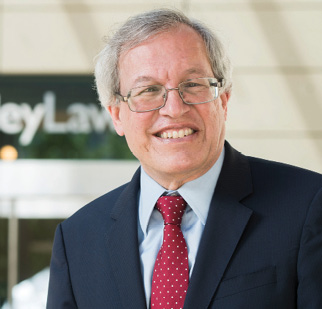
Erwin Chemerinsky is dean of the University of California at Berkeley School of Law. He is an expert in constitutional law. He’s also the author of many books, including his most recent ones: Campus Speech and Academic Freedom: A Guide for Difficult Times and The Supreme Court October Term 2024: Taking Sides.
This column reflects the opinions of the author and not necessarily the views of the ABA Journal—or the American Bar Association.