Every so often, a legal show comes along that makes me ask one important question: WTF am I watching? That’s roughly the experience of viewing Strip Law, the latest legal comedy on Netflix.
The adult animated sitcom centers on a group of flamboyant attorneys who take on outrageous cases and market themselves with all the subtlety of a monster-truck rally and the restraint of a sleazy stand-up comedian.
I approached the show with skepticism. After all, television lawyers usually fall somewhere between Atticus Finch’s saintly demeanor and Saul Goodman’s theatrical chaos.
Strip Law plants its flag firmly in the latter territory—then replaces the flagpole with a neon billboard, pushes all the chips to the middle, and lights the poker table on fire in a way that only an animated comedy could.
And honestly, I’m kind of a fan. Kind of.
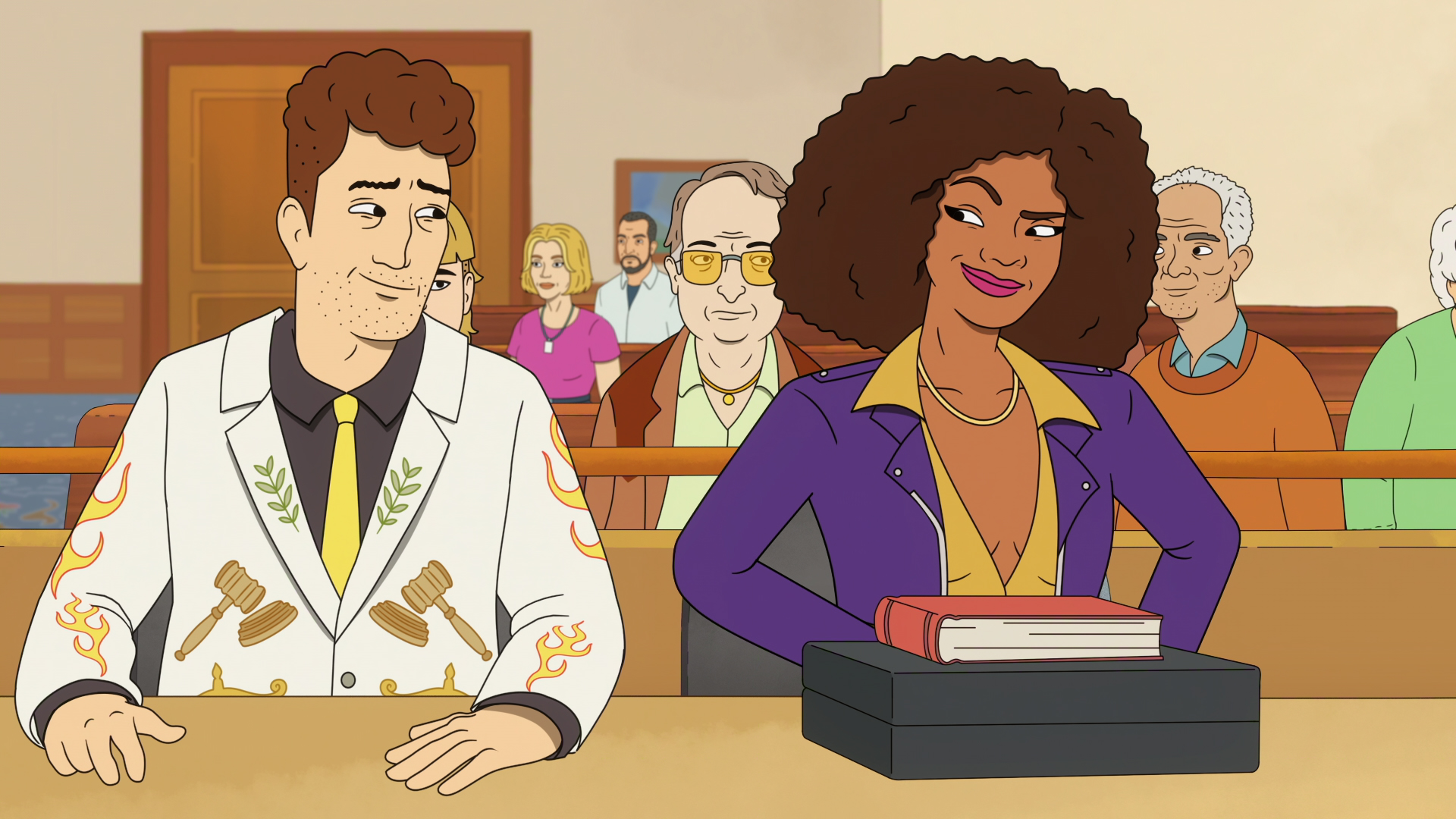
The series follows struggling Las Vegas attorney Lincoln Gumb, who after a personal and professional low point partners with Sheila Flambé, a quick-thinking street magician. Together, they devise ways to turn trials into high-energy performances, blending entertainment and advocacy to attract attention and clients.
The pilot wastes no time establishing its thesis: Law is secondary, showmanship is everything.
In the first episode, Lincoln represents exotic dancers challenging a contract clause that requires them to swallow metal keys. The opposing counsel? Lincoln’s deceased mother’s ex-law partner, now a hypermarketed Vegas legal titan who literally fires Lincoln via television commercial.
Unable to win on the law, Lincoln pivots—under Sheila’s guidance—to winning over the jury through spectacle. It’s absurd, yes—but it reflects a recognizable anxiety: In certain venues, persuasion often feels like theater, and most fact-finders aren’t easily entertained.
“These jurors, they walk by two burning pirate ships, 10 dancin’ fountains and a dead clown on their morning commutes,” Sheila says, by way of explaining what she brings to the firm. “They’re not going to be impressed by some hundred-year-old laws in a moldy old book.”
Sadly, the commentary extends beyond Las Vegas to today’s social media landscape as well.
Aside from the employment-ending commercial mentioned earlier, advertisements play a significant role throughout the episodes. The Strip Law attorneys compete for clients using absurd commercials, roadside spectacles and publicity stunts that make viewers wonder whether the goal is satire or shock value.
You’ve probably spotted billboards for attorneys styled like professional wrestlers or action heroes. Well, the show clearly takes inspiration from real-life legal marketing legends we’ve all seen and know—those attorneys whose omnipresent signage could guide lost pilots back to civilization.
Strip Law depicts Las Vegas as a hypercommercialized legal ecosystem, inspired by the real-world observation that attorney ads dominate local airwaves, and asks, “What if we stopped pretending this wasn’t entertainment?”
Does the series exaggerate? Of course; it’s totally out of left field, and the production team goes out of its way to make a total mockery out of its premise. But that’s the point—it’s a spectacle with source material. After all, according to creator Cullen Crawford, Strip Law was inspired (at least partly) by a trip he took to Las Vegas and the inundation of lawyer commercials he was subjected to in his hotel.
And here’s the uncomfortable truth: The theme isn’t that far off. Ridiculous? Absolutely.
But attorneys watching will recognize the underlying apprehension: Client acquisition is survival.
Unlike TV prosecutors or public defenders, private-practice lawyers don’t receive a steady stream of cases from the government. Sure, I know plenty of defense attorneys on the federal Criminal Justice Act panel, but most of us have to rely on eating what we catch. If the phone doesn’t ring, the lights go out.
That pressure is what drives the real-world marketing creativity that Strip Law lampoons so effectively. Lincoln’s firm is constantly chasing clients who haven’t paid, improvising revenue streams and reinventing itself to stay afloat. But beneath the neon billboards and punchlines, the show taps into a real struggle attorneys face: the constant need to generate revenue. And it’s a struggle that, frankly, doesn’t get enough spotlight.
Law school teaches you about torts, civil procedure, contracts and other aspects of core legal concepts. It doesn’t teach you how to attract work, manage cash flow or ethically compete for clients in an environment glutted by other attorneys, many of whom have much bigger marketing budgets.
The idealist in me thinks Strip Law’s attorneys behave like carnival barkers because the show understands a core truth about private practice: Legal work is only a small part of it. The rest includes networking, marketing, branding, managing overhead and chasing unpaid invoices.
If you’re lucky, you also have time in there to remember why you went to law school in the first place.
The series exaggerates this reality for comedic effect, but its message lands clearly. Financial pressure shapes legal practice more than most law students or the general public realize. Every contingency-fee lawyer watching the show will recognize the unspoken tension behind every case discussion:
“Is this justice … or is this rent money?”
Overall, I enjoyed the show for what it is. Strip Law exudes the same type of random, disconnected, pop-culture-reference humor that made shows like Family Guy famous. Still, it’s not without its faults.
Sometimes the humor falls flat, feeling like mere shock value. There’s plenty of instances throughout Season One where I felt the show tried too hard to find an edge. Often, the satire steers so far from the law that it seems nothing more than an attempts to trigger the audience.
Additionally, there’s often an overreliance on crude humor. Don’t get me wrong, I’m a fan of it when it’s done well, but offense for shock value’s sake is abrasive and unoriginal. On top of that, the writers’ randomness and “pedal to the metal” approach can ruin pacing and dilute stronger jokes with a faulty “more is more” attitude.
For most, Strip Law probably works best if you forget the legal aspect and view its references to the law as nothing more than a backdrop. For lawyers, if you’re willing to dig a bit deeper, the show can still land by poking fun at truths we would rather not admit:
Legal skill does not equal financial stability.
Client acquisition is existential.
And for many, dignity is often negotiable when payroll is due.

Adam Banner
Adam R. Banner is the founder and lead attorney of the Oklahoma Legal Group, a criminal defense law firm in Oklahoma City. His practice focuses solely on state and federal criminal defense. He represents the accused against allegations of sex crimes, violent crimes, drug crimes and white-collar crimes.
The study of law isn’t for everyone, yet its practice and procedure seem to permeate pop culture at an increasing rate. This column is about the intersection of law and pop culture in an attempt to separate the real from the ridiculous.