By Thomas W. Lyons and William D. Johnston
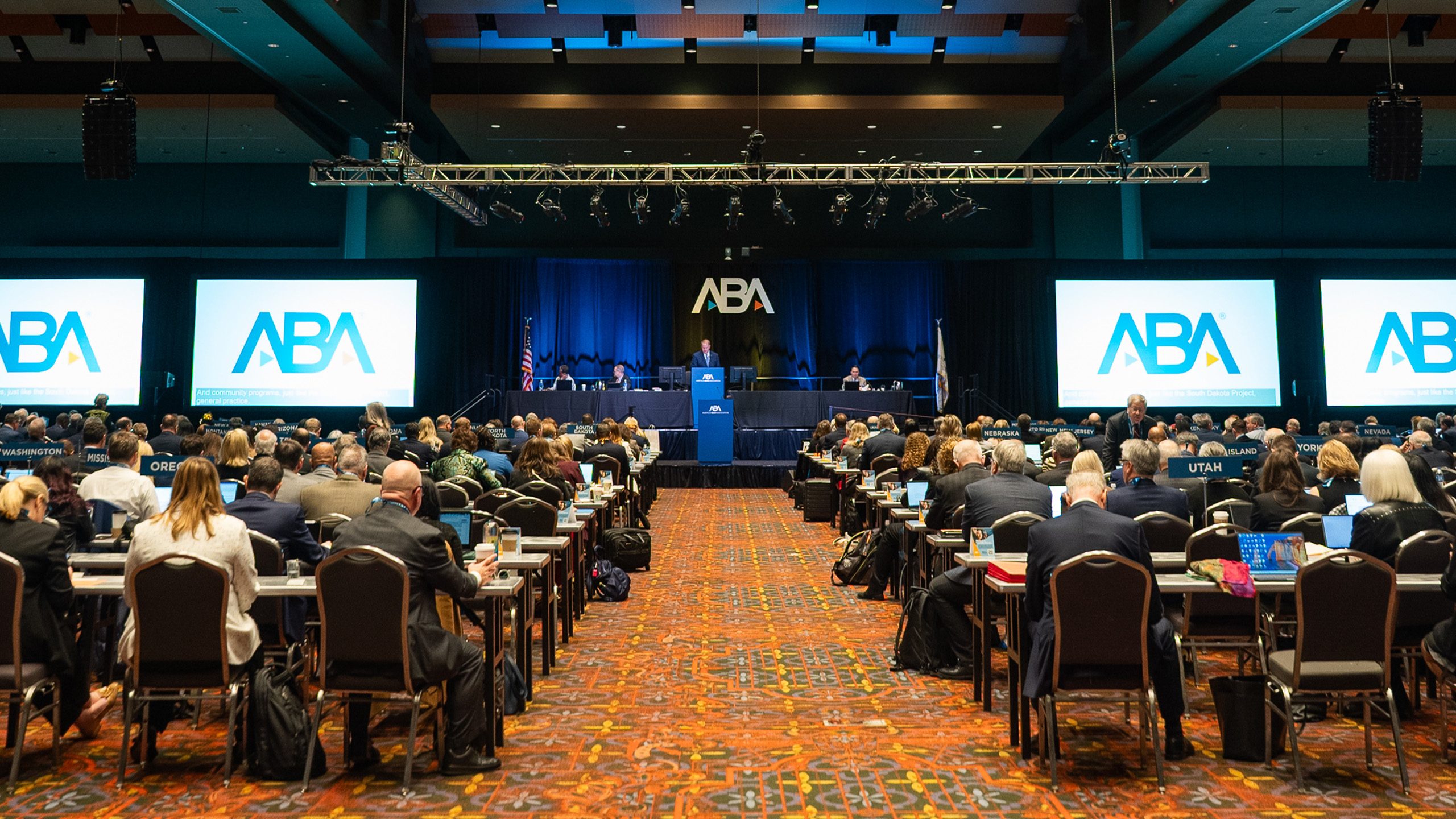
On Feb. 9, the ABA House of Delegates approved, revised and amended Resolution 702, adopting it as ABA policy. The resolution’s first “resolved” clause states: “That the American Bar Association supports and encourages free, open and civil discussion and debate on legal and policy matters among its members and recognizes there is value in having lawyers with a wide range of different views participate meaningfully in ABA leadership, programming, policy, and advocacy.”
To many, this may seem like an unremarkable proposition, yet the path to adoption was quite remarkable. It involved several current and past presidents of the Association, and a sustained engagement between a relatively new and informal group within the Association called the Crossroads Caucus and members of the Association’s Center for Diversity, Equity and Inclusion and the Section on Civil Rights and Social Justice. The process itself proved the resolution’s premise: We get better results when people with a variety of perspectives participate in discussing issues and making decisions.
The Crossroads Caucus was formed in 2022 with the hope of presenting alternative perspectives on legal and policy issues within the ABA. The group’s founders included three members of the ABA Board of Governors and other leaders within the Association. The Caucus’s initial version of Resolution 702 was met with opposition and was withdrawn prior to calendaring. In November 2025, the Caucus prepared another version, including a report with additional research to support it.
President Michelle Behnke learned that the DEI Center and the Section of Civil Rights and Social Justice opposed it. She asked Past Presidents Linda Klein and Deborah Enix-Ross to see whether they could resolve the differences among the proponents and the resolution’s critics.
That process began in December. It involved meetings with each side, exchanges of proposed revisions, plenary Zoom meetings and a substantially revised report. The process culminated in a three-hour in-person meeting facilitated by Past President Klein, with the participation of Bill Johnston, Jo Ann Engelhardt and Tom Lyons on behalf of the Caucus, Wendy Shiba from the DEI Center, and Mario Sullivan and Paul Smith from the CRSJ Section, to produce a consensus document that was sent to the House of Delegates the evening of Feb. 6. These sustained efforts should dispel any suggestion that the Resolution is symbolic or trivial. It was hard won because it addresses a consequential concern.
Two amendments adopted on the House floor further clarified the resolution’s scope. One clarified that the Resolution represents a continuation of the Association’s efforts to promote diverse views. Past President Judy Perry Martinez requested that the resolution make clear that bar associations, law firms and others in the legal community should be respectful to people with a wide range of different views, but need not respect those views themselves. Both points reinforce a central truth: Inclusion of perspective does not require agreement, but it does require openness.
The report, as revised, states: “A growing body of research has found that organizations ‘that welcome diverse perspectives become more likely to question assumptions, consider alternative viewpoints and engage in constructive debate. This collaborative process helps to identify potential blind spots, unconscious biases and risks that homogeneous groups might overlook.’”
Further, “These discoveries apply in the legal setting as well. ‘To successfully represent their clients, lawyers need to understand all sides of an issue, which is why research shows that ideologically diverse teams are more effective teams. If liberal or progressive lawyers are not exposed to conservative viewpoints, they will be less effective as advocates … .’ The same is true for conservative and even nonideological lawyers.”
The resolution also aligns squarely with the ABA’s own Strategic Plan. A “home for all lawyers” cannot exist if meaningful participation is limited to those who share prevailing views. A “culture of belonging” requires more than rhetoric; it requires structural openness to dissenting perspectives. And the recognition that no individual or group holds a monopoly on insight is not aspirational—it is essential.
The Association’s Goal III, “Eliminate Bias and Enhance Diversity,” has as its first objective to promote “full and equal participation in the Association, our profession, and the justice system by all persons.” This resolution furthers participation in the ABA by encouraging lawyers and the rest of the legal community to participate in their ABA entities by freely expressing their diverse views, thus avoiding echo chambers. The Report states: “This Resolution is intended as additive, not restrictive. ABA entities that were created to promote a particular mission will remain focused on their missions and need not include opposing perspectives in their leadership.”
Moreover: “The legal community deserves an ABA that has considered objections and novel views that indeed may lead to better policy. When the ABA selects members of CLE panels, programs and publication submissions, it should consider including diverse perspectives on the topic, while recognizing that not every topic will necessarily require debate. As the resolution notes, if there is to be greater diversity of thought in the House of Delegates, people with diverse views must be willing to speak and be encouraged by the ABA and its leaders to do so.”
The sponsors and Past President Enix-Ross then presented the revised, amended resolution to the House. Mr. Lyons described the process by which the Resolution came to that point. He noted that President Behnke in her remarks to the House had said: “We want lawyers to model good discussions and debates, and we want these discussions and debates to be inclusive and civil.” Mr. Johnston stated: “The Resolution presents a modest but critically important proposal: for the ABA to reaffirm its commitment to welcoming different views. In doing so, we will truly be the national representative of the legal profession.”
Past President Enix-Ross was emphatic that “encouraging diverse viewpoints is not about division—it is about strength.” She continued: “Institutions are at their best when they welcome a range of perspectives, experiences, and ideas. Diversity of viewpoint sharpens our thinking, tests our assumptions, and leads to better decision-making. It is how we avoid blind spots and groupthink, and how we ensure that our work reflects the complexity of the world we serve.”
She also stressed that the resolution articulates a core value of the Association, adding: “Encouraging diverse viewpoints also reinforces our commitment to fairness and legitimacy. When people believe their voices can be heard—even when they dissent—they are more likely to trust the process and the institution itself. That trust is essential to our credibility and to the rule of law.”
In the end, Resolution 702 is forward-looking in the most important sense. It recognizes that complex problems demand more than a single lens and that progress depends on open dialogue. By affirming the value of diverse viewpoints, the ABA strengthens its capacity to lead, to innovate, and to serve the profession with integrity.
Thomas W. Lyons and William D. Johnston were co-sponsors of Resolution 702. They can be reached at [email protected] and [email protected].
This column reflects the opinions of the author and not necessarily the views of the ABA Journal—or the American Bar Association.