March Madness is underway. But alleged madness of a different sort hit men’s college basketball in January when federal prosecutors charged 20 current and former players with wire fraud, conspiracy to commit wire fraud and bribery in sporting contests.
The indictment in U.S. v. Smith alleges a group of “fixers” agreed to recruit NCAA players who would help ensure their teams failed to cover the point spread of the first half of a game or an entire game.
According to the indictment, players were offered payments, usually ranging from $10,000 to $20,000 per game, to participate in the scheme. The fixers would then place bets against the team whose player or players they had bribed, the indictment says.
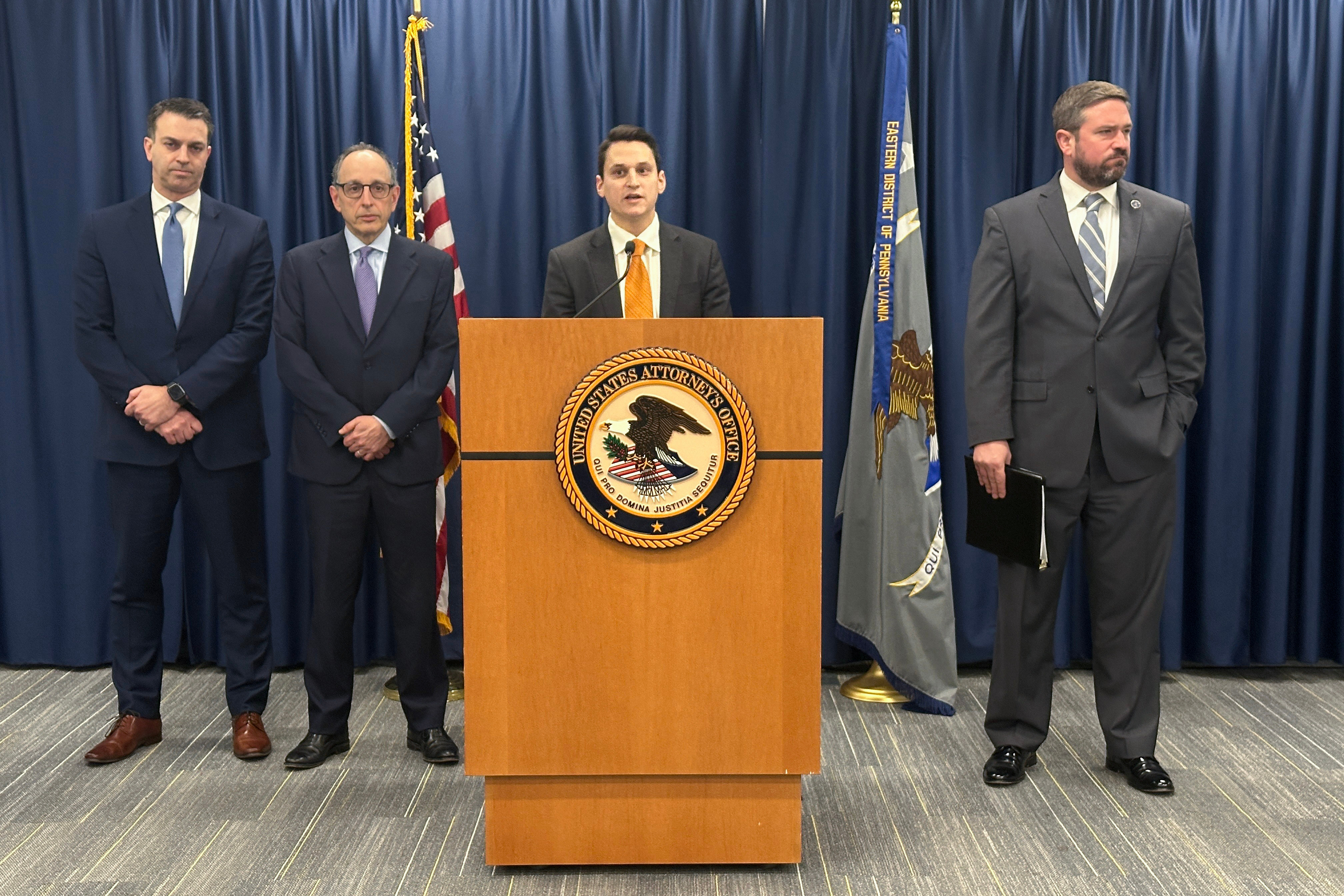
David Metcalf, the U.S. attorney for the Eastern District of Pennsylvania, in January announced charges against 20 college basketball players for allegedly participating in a betting scheme. (AP Photo/Tassanee Vejpongsa)
The charges come on the heels of the October indictment of longtime NBA player Terry Rozier, who is accused of tipping off a friend that he planned to leave a 2023 game early with a purported injury to help a group of gamblers place successful wagers based on this information. Specifically, the gamblers bet on Rozier’s “under” statistics, meaning he would have less than a certain number of points, rebounds and assists. Rozier left the 2023 game after nine minutes.
But will the wire fraud and conspiracy to commit wire fraud charges lead to convictions?
In the most notorious sports fixing case of all time, the Black Sox scandal, eight Chicago White Sox players received lifetime bans after being accused of having roles in intentionally losing the 1919 World Series in exchange for payments from gamblers. It is worth noting, though, that the players were acquitted of all criminal charges.
Greg Brower, a former U.S. attorney for Nevada and a shareholder at Brownstein Hyatt Farber Schreck in Las Vegas, called the case involving the college basketball players “an absolute bombshell.” But, addressing the charges against the players, Brower asked whether it was really a federal crime.
Brower was a panelist at a February webinar, “The Sports Gambling Scandals: An Exploration of the Civil and Criminal Liability When Sports, Gambling and the Law Intersect,” organized by the American Bar Association’s Criminal Justice Section.
As for the Rozier case, “There are compelling arguments that this is not a traditional violation of the wire fraud statute [18 U.S.C. § 1343] in the way it is drafted,” said another panelist from the webinar, Jennifer Schubert, a former federal prosecutor who now practices at MoloLamken in New York City.

In the Terry Rozier case, there could be good arguments that what he’s charged with isn’t a traditional wire fraud violation, Jennifer Schubert says.
A recent U.S. Supreme Court ruling may point in that direction. In 2023’s Ciminelli v. United States, the Supreme Court overturned a conviction for wire fraud and conspiracy to commit wire fraud, finding that victims must be deprived of actual property rights.
Mere information is not a protected interest, the court explained. Otherwise, “almost any deceptive act could be criminal.”
Citing Ciminelli, Rozier’s attorney Jim Trusty filed a motion to dismiss, claiming the indictment only alleges violations of certain sportsbooks’ terms of use. The defendants in the college basketball case may follow a similar path.
“The argument is that the sportsbook as a victim wasn’t deprived of any tangible property, which is required under the federal wire fraud statute,” Brower says.
Robert Boland, a Seton Hall Law professor and a former athletics integrity officer at Penn State, called the wire fraud charges against the college basketball players “complicated,” and says they may turn on how the players were recruited into the alleged conspiracy.
“Did the gamblers come personally? Did they text? How did this scheme take place? It would depend on how these young men were recruited into the conspiracy and how they exchanged information,” says Boland, who also is a partner at Shumaker, Loop & Kendrick in Toledo, Ohio. He adds that the case may have been “a bit overcharged.”
College athletes at risk
Speaking with the ABA Journal last fall, James Nussbaum, a former in-house counsel at Indiana University and a partner with Church Church Hittle & Antrim, said college athletes are especially susceptible to being targeted by unsavory bettors.
“It’s a lot more widespread than people want to believe,” Nussbaum said.
Boland agrees, saying that any athlete being involved in a conspiracy to fix a game was his “existential fear” while working as an athletics integrity officer.
“Almost every study suggests that young men 18 to 24 are at exceptional risk to becoming addicted to sports betting and gambling,” he says.
“There are not a lot of sheriffs watching, if you will. Penn State was in a unique position in that they had a full-time experienced lawyer to help set up some of the training and process, but not everybody has those same resources,” Boland adds that “mid-major college players who are living in the [name, image, and likeness] era probably see everybody making money and are easy to recruit into this kind of conspiracy.”

Gambling has always been an issue in college sports, says Jay Bilas, a lawyer and ESPN college basketball analyst. (Photo by Ethan Miller/Getty Images)
But Jay Bilas, an ESPN college basketball analyst who is also an attorney and was a four-year starter at Duke University in the 1980s, somewhat disagrees. He cites gambling scandals from the 1950s, ‘60s and ’70s.
“It doesn’t strike me as more prevalent now. It’s always been there. I think it has less to do with the gambling piece and more with athletes and others that find themselves in compromised positions, and they’re leveraged for it,” Bilas says.
Brower voiced a similar sentiment.
“The vulnerability of college athletes is nothing new. It has always existed,” he says. “We’re just finding out more now, and that’s a good thing. The transparency is greater” with legalized gambling.
During his collegiate days, Bilas never heard of a player being approached. “Every year, there was an FBI special agent that would come in and give a presentation on gambling,” he adds. “But that was never a concern. It was like they had come in and told us to beware of avalanches. It seemed so remote from our experience.”
Bilas notes there is no question the landscape has changed in certain respects. He said that when he first started in broadcasting, for instance, an announcer would never mention a point spread on television. But he is keenly aware of the gambling element and that a segment of the audience is putting money on the games.
What’s next?
As for what will happen with the charged basketball players, Boland says many of them may not have as much of an ability to fight back as an NBA player like Rozier would.
“The problem for them is the cost of a criminal defense—and a prosecution of this size is going to be in the hundreds of thousands of dollars—or they’re going to have federal public defenders,” he notes. “They’re going to be inclined to probably want to avoid jail.”
Boland adds that a key question will be if there is a larger conspiracy that the players can point the government toward.
“Most of these players are, in my mind, somewhat sympathetic and somewhat victims themselves in the process. They were young people who saw a system awash in money, and who said, ‘Hey, let me get in on this.’”

Bilas disagrees. He says the players are young adults who knew the score.
“Gambling for the most part is legal, but there are certain aspects that are illegal, and everybody knows what it is,” Bilas said. “It’s not like you have to be tutored on this and dig deep into the tax code to figure it out in a gigantic book. It’s not difficult.”
He adds that there are steps that can be taken by states and Congress itself to limit prop bets, but the experts agreed the genie is out of the bottle when it comes to gambling on college sports.
Boland says the NCAA can do more to work with universities to provide training.
“They should be working really strongly to message to their athletes, and that messaging to me so far has been missing,” he contended. “You should never allow a crisis to pass without a great learning opportunity.”