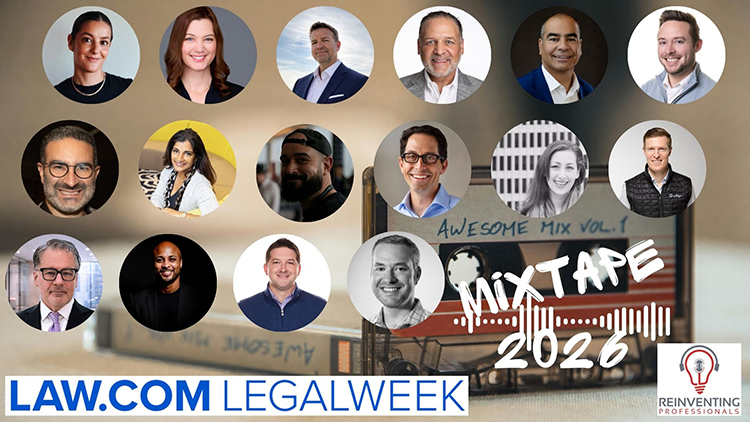
Ari Kaplan, a legal industry analyst and the host of the Reinventing Professionals podcast, recently spoke with attendees at the 2026 Legalweek conference about current trends and opportunities in the legal sector for his annual mixtape.
Ari Kaplan: What are the most important marketing considerations for an event like Legalweek?
Narin Olsson Akay, director of marketing, DeepJudge: In many ways, events like Legalweek are like window shopping. They offer a chance for people to see who you are, what you do, what you stand for and what you’re building as a company. Of course, there are the obvious elements, such as strong branding, creative activations and the need to break through the buzz in a highly crowded environment. But the real value goes far beyond that. At its core, events are about connecting with people. It’s about the smaller gatherings, the one-to-one conversations, meeting new people and deepening relationships with those you already know. That’s where relationships truly begin to take shape, often proving more valuable than any promotional activity or visibility.
Ari Kaplan: What is driving interest in AI within the legal field?
Ashley Allman, senior director, FTI Technology: A key driver is that AI is now widely used in everyday consumer contexts, making it easier for legal professionals to adopt it in their work. This familiarity, combined with the technology’s capabilities and potential, is fueling widespread interest and excitement. In fact, Legalweek has become heavily centered around AI, marking a resurgence in energy and engagement compared to previous years. It reflects a shift toward more focused innovation in legal technology.
Ari Kaplan: What is the value of attending Legalweek?
Tim Brady, CEO, Colligo: The event has strong energy and a high concentration of clients, partners and prospects all in one place. It has been a busy and productive week filled with valuable conversations. Many questions focus on how organizations can adopt and use SharePoint as a document management system, particularly for those not yet using it. There is also significant interest in how tools like Copilot can be leveraged, which requires properly structured data within SharePoint, including emails and attachments. As a result, many conversations center on preparing data environments to fully leverage AI capabilities.

Ari Kaplan. (Photo by Tori Soper)
Ari Kaplan: How do you demonstrate AI fluency across various disciplines?
Michael Connor, chief revenue officer, Cimplifi: Demonstrating AI fluency involves orchestrating the use of AI across the different components of the EDRM, with an increasing focus on earlier stages of the process. There is an emphasis on moving further left, applying AI before traditional stages like hosting and review, and leveraging it across each phase to fully realize its benefits and improve overall efficiency.
Ari Kaplan: What trends are you seeing this year?
Sean Fitzpatrick, CEO of the global legal business, LexisNexis: There has been a shift from testing AI solutions to actively adopting them. While efficiency remains important, trust has become a central concern due to issues like hallucinated cases and quotes appearing in legal work, even in court filings and judicial opinions. This has highlighted that using unverified AI outputs does not meet legal standards. There is also significant growth in AI-driven drafting tools, particularly those grounded in authoritative legal content, which is driving rapid adoption. Law firms are seeing increased demand and revenue growth while keeping hiring relatively flat, using technology to reduce nonbillable work and take on more billable work without increasing head count.
Ari Kaplan: What is the role of a legal tech general counsel at Legalweek?
Dennis Garcia, vice president and general counsel, Litera: The role includes learning about the legal technology marketplace, understanding competitors and identifying how to differentiate solutions. It also involves serving as an ambassador by meeting with customers, particularly in-house legal teams, to understand their priorities, share firsthand experiences with the company’s tools, and proactively engage with key customer segments.
Ari Kaplan: What makes a great event?
Timo Karakashev, founder and CEO, Cosmonauts: A great event is defined by the people, particularly having the right balance between buyers and sellers. While event features and sophistication continue to evolve, they are secondary to meaningful human interaction. Conferences remain a critical channel for legal tech companies to connect with potential buyers, especially in an industry driven by relationships and trust. Lawyers tend to engage and make decisions based on personal connections, favoring organizations they find reliable and collaborative. As technology becomes more accessible through AI, success will depend not only on strong operational execution but also on the ability to build genuine relationships. The most successful companies excel in both areas, demonstrating strong internal operations and effective relationship-building with clients and partners.
Ari Kaplan: How are technology companies managing growth in this environment?
Dan Malgran, vice president of marketing, Steno: Growth is driven by combining the DNA of a service company with that of a technology company. This involves building technology alongside customers by continuously engaging with lawyers and paralegals to understand their workflows. Embedding the audience directly into the company enables faster development, better products and quicker adoption because the solutions align with existing workflows. In contrast, companies that require users to change workflows often experience slower growth due to the learning curve and resistance to change. Our marketing approach emphasizes building with customers, rather than for them. This is reflected in experiential engagement, such as creating opportunities for attendees to actively participate and build something alongside the company. This reinforces the company’s core message of collaboration and cocreation.
Ari Kaplan: What can in-house leaders expect from Legalweek?
Shai Mehani, co-founder and CEO, In-House Connect: This conference is great for in-house leaders who are looking to be on the cutting edge of innovation. Nearly every legal tech vendor that has made substantial investments in providing great tools for in-house legal teams is present. Attendees can learn more about what these vendors are doing, why they are different and what makes their tools special. These tools can unlock tremendous value and efficiency for legal departments. It is also a great opportunity to stay informed about what is happening next in legal tech, supported by strong CLE programming developed by thought leaders.
Ari Kaplan: What are your impressions of your first Legalweek?
Mary Miller, chief marketing officer, KLDiscovery: The experience has been highly positive, with valuable learning opportunities and strong engagement with attendees. The sessions have been heavily focused on AI, reflecting its importance as a major trend, and participants have shown a high level of curiosity and interest. One notable surprise was the significant international presence, with many attendees traveling from regions such as Asia and Europe. There was strong global interest in learning about new technologies, with attendees particularly eager for demonstrations and a deeper understanding of the solutions being presented.
Ari Kaplan: What is your key takeaway from this year’s Legalweek?
Bill Roberts, head of corporate communications, Disco: It is interesting to see how AI is shifting from vague, ill-defined use cases to delivering practical, tangible applications across various areas of law, including transactional work and e-discovery. The promise of the technology is becoming clearer and more meaningful compared to past years. Over the next year, we will likely see significant leaps forward, and it will be remarkable to see how much more capable the technology becomes and what new possibilities emerge beyond what is currently being explored.
Ari Kaplan: Is Legalweek meeting your expectations?
Joshua Schnoll, chief marketing officer, Everlaw: Yes, Legalweek is always a great time to meet with customers, service providers and prospects. It has been especially valuable for connecting with and growing our partner community and for bringing together key stakeholders in one place. The Javits center is definitely new, but from a content and conversation standpoint, it doesn’t feel that new, as the major shift toward AI has already occurred in previous years. AI is now fully integrated into how legal technology is delivered, becoming a standard component, rather than a novel feature. The shift in focus is on how AI changes traditional workflows, for example, shifting a sequential discovery process to one that enables the development of strategic insights earlier. AI now enables senior legal professionals to engage directly with massive datasets from the outset, fundamentally changing how legal strategy is formed before detailed review begins.
Ari Kaplan: How is this year’s Legalweek conference different?
Joey Seeber, CEO, Level Legal: The event felt very different from prior years. In addition to the new venue, it was a positive experience, with successful interactions across multiple activities, including events, dinners and exhibits. Our team achieved its goals by strengthening relationships, renewing contacts and engaging meaningfully with clients. Follow-up is crucial, and we are now reconnecting with new contacts, continuing conversations with existing clients, and maintaining engagement after the event to build on its success.
Ari Kaplan: What ideas are you taking away from Legalweek to help empower CLOC?
Oyango Snell, president and CEO, Corporate Legal Operations Consortium: There is strong demand for deeper discussions around legal operations, particularly practical and substantive aspects, rather than just foundational concepts. Legal operations is increasingly seen as a strategic driver within organizations, helping move in-house legal teams forward. There is also valuable insight into how legal tech vendors are approaching partnerships, with a clear need for them to better understand the business challenges of in-house teams and focus on building meaningful, solution-oriented relationships, rather than purely sales-driven interactions.
Ari Kaplan: What questions are you receiving from Legalweek attendees?
Beau Wysong, senior vice president of marketing, Opus 2: Many attendees are interested in how our platform can be extended beyond traditional litigation use cases. They are exploring applications such as collaboration, client portals, legal service delivery and other repeatable workflows, seeking inspiration on how to leverage the platform more broadly. That interest is driven by trust in established technology. With a strong track record, firms are confident in expanding usage into new areas and replacing outdated or fragmented systems with more integrated and innovative solutions.
Ari Kaplan: What type of partnerships are you hoping to build at this year’s Legalweek conference?
Emma Raimi-Zlatic, director of partnerships and events, Smokeball: The goal is to build a wide range of partnerships, including API integration partners that can work within the platform, vendors with shared clients, consulting agencies that can help expand reach, and education-focused partners. The approach is open and flexible, aiming to collaborate with a range of organizations that can complement and extend the platform’s value.
Listen to the complete interview at Reinventing Professionals.
Ari Kaplan regularly interviews leaders in the legal industry and in the broader professional services community to share perspective, highlight transformative change and introduce new technology at his blog and on Apple Podcasts.