This post is part of Challenging Precedent, a blog of the Stanford Center for Racial Justice examining race, law, and regulation in the Trump era.
In February, the Trump administration dropped its appeal in the Ninth Circuit Court of Appeals of a court order blocking the deployment of National Guard troops in Portland, Oregon. This was a stark and surprising ending to the administration’s legal battle in Oregon that started in September of 2025 after President Trump ordered the federalization of the Oregon National Guard troops in response to anti-ICE protests. The administration’s withdrawal has been celebrated by Oregon’s lawyers and democratic leaders as a win for the state and people of Oregon, but many legal scholars are left wondering what will happen next. Does this withdrawal signal a policy shift or a tactical pause? The answer may lie in the Supreme Court’s latest rulings on the limits of federal enforcement and executive overreach.
In 2025, California, Oregon, and Illinois filed lawsuits against the Trump administration’s deployment of the National Guard and use of military force against civilians. While a federal appeals court allowed the deployment to continue in California, district courts in both Oregon and Illinois blocked the administration’s efforts. The Seventh Circuit proceeded to uphold a block on the administration’s deployment of federalized National Guard troops. After the Supreme Court affirmed the Seventh Circuit’s decision, the Trump administration dropped its appeal in Oregon, likely recognizing that the ruling had undercut its legal basis.
The Supreme Court’s reasoning was fractured into four opinions anchored in identifying the appropriate definition of “regular forces” and the scope of “executive inability.” The Court’s definition stems from 10 U.S.C. § 12406, a federal statute allowing the president to call up the guard when he is “unable with the regular forces to execute the laws of the United States.” The majority holds that “regular forces” refers to the United States military. Furthermore, the Court holds that the president can only federalize the Guard where there is proof that the actual U.S. military is unable “to execute the laws of the United States.” Justice Kavanaugh concurs on narrower procedural grounds, agreeing with the Majority’s decision to block the National Guard’s deployment in Illinois, but noting that President Trump had not officially found the armed forces unable to act.
Alternatively, Justices Alito and Thomas object to the definition of “regular forces.” They disagree with the majority’s interpretation of “regular forces” to refer to the U.S. Military and interpret “regular forces” to encompass civil law enforcement such as Immigration and Customs Enforcement agents. Justice Gorsuch argues that the majority should be more cautious when deciding cases on “sensitive and gravely consequential questions” that could limit the president’s perceived authority and should have ruled more narrowly. Gorsuch communicates his desire to show deference to the evidence presented that suggests that government officials were facing restricted operational capacity.
The decision significantly restricts executive power under the Posse Comitatus Act of 1878, a federal law limiting the U.S. military from participating in domestic law enforcement, such as arrests or searches, unless they are expressly authorized by Congress or the Constitution. In many ways, this federal law reflects a deep skepticism of military involvement in civilian affairs, recognizing that such interference can threaten democratic governance and individual liberty.
However, 150 years later, the Court’s holding that the Act applies to 10 U.S.C. § 12406 effectively requires the president to exhaust the regular military first, an even more restrictive path given the strict legal limits and high threshold for deploying military force domestically. Consequently, Trump v. Illinois represents a critical turning point in the legal battles against President Trump’s deployment of the federal guard. The Court seemingly imposed a significant limitation on the president’s authority to deploy the National Guard by finding his statutory authority (10 U.S.C. § 12406) is only authorized where the “regular forces” (military) are unable to enforce the laws.
For opponents of the deployment, the ruling may seem like a success because the Court upheld the injunction blocking the deployment. This may, however, incentivize the president to send the military into domestic conflict instead of the National Guard because the Insurrection Act, unlike 10 U.S.C. § 12406, is an exception to the Posse Comitatus Act. While Trump v. Illinois appears to curb federal overreach, the ruling may actually expand the administration’s authority by defining new, unchecked pathways for deploying federal force under the guise of “emergency” security.
Altogether, what does this decision mean for federal limitations of executive force? One of the leading theories post-Trump v. Illinois is that the Supreme Court’s ruling potentially will not reduce the federal government’s exercise of power, but rather it will provide incentives for the administration to broaden the scope of power through other means.
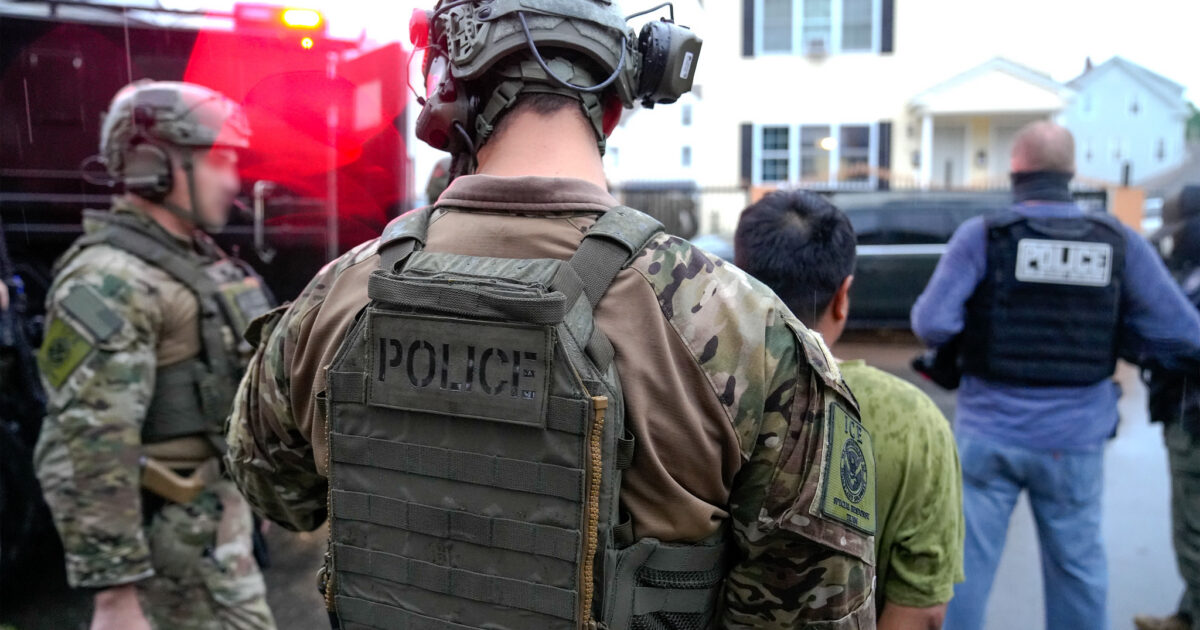
For example, this past January President Trump threatened to invoke the Insurrection Act after an Immigration and Customs Enforcement officer killed René Nicole Good, a 37-year-old mother, amidst anti-immigration protests in Minneapolis. The Insurrection Act is a rarely used exception to the Posse Comitatus Act authorizing the president to deploy military forces inside of the United States to suppress rebellion or domestic violence. President Trump wrote on Truth Social, “If the corrupt politicians of Minnesota don’t obey the law and stop the professional agitators and insurrectionists from attacking the Patriots of I.C.E., who are only trying to do their job, I will institute the Insurrection Act …”.
This is not the first time that the Trump administration has threatened to use the Insurrection Act. Months earlier, in October 2025, Trump told reporters on Air Force One that he was “allowed” to use the Insurrection Act and that there would be “no more court cases, there is no more anything … we can always use the Insurrection Act if we want.” Trump’s statement specifically targeted democratically led cities and states whose leaders were blocking and limiting his ability to send National Guard troops. By explicitly limiting the president’s authority under 10 U.S.C. § 12406, the ruling in Trump v Illinois has, arguably, created incentives for the Trump administration to utilize the Insurrection Act as a way to federalize National Guard troops.
Rather than a victory for state sovereignty, Trump’s Oregon withdrawal paired with Trump v. Illinois may be viewed as a tactical regrouping. By retreating now, the administration may clear the path to return with the force required to trigger the Insurrection Act.
This incentive puts protesters on precarious footing because their acts may create the factual basis needed for the president to invoke the Insurrection Act. Under this theory of federal action, the federal police forces are seen as agents stoking the flames of civil unrest and disobedience in order to justify the use of the Insurrection Act. In other words, they are seen as creating the circumstances necessary to expand the administration’s exercise of federal power. With this in mind, protesters are left to walk a fine line between speaking out against the administration and becoming an unwitting agent in the administration’s pretext activity. This tension is likely to chill free speech broadly, especially for immigrants and their close relatives.
This framework necessitates a critical look at the unconventional and expansive methods the administration might adopt to execute federal authority within domestic borders. Many scholars and practitioners have confronted the sobering possibility that constitutional protections are no longer a shield for the domestic sphere, but merely a suggestion to be bypassed by the next executive “emergency.”
Samantha Taylor is a student at Stanford Law School.

Source link