The Bay Area is grappling with a pressing public safety concern: highly unsafe roads. This summer, San Francisco’s mayor committed to improving a dangerous intersection when a four-year-old died after being hit by a car. In San Jose, a driver crashed into a woman and two little girls, killing an infant and marking the city’s 26th fatal collision in 2023. Furthermore, Oakland’s Department of Transportation released a report declaring that fatal crashes had reached the level of a “public safety epidemic.”
This crisis, however, is not unique to the Bay Area. Across the country, traffic deaths have continued to increase, surpassing pre-pandemic rates. And traffic fatality rates for both pedestrians and motorists highlight racial disparities. In 2018, the fatality rate for Black pedestrians was nearly twice the rate for white pedestrians. Researchers at the University of North Carolina have further identified an association between formerly redlined neighborhoods and pedestrian fatalities. Poorly designed streets, often clustered in Black and Latino neighborhoods, also make these incidents more likely to reoccur.
Since 2020, national and local conversations on how to address these concerns and improve traffic safety have coincided with conversations rethinking the role of police. Within the Bay Area, there has been a significant policy movement centered around how communities can protect residents from the harms posed by the roads, while also ensuring Black and Latino drivers and pedestrians are not disproportionately subjected to traffic enforcement by police. This means that communities have looked to new, creative ways to promote traffic safety on their streets beyond police enforcement.
Supporting these efforts, several Bay Area cities received grants from the U.S. Department of Transportation earlier this year due to higher-than-average traffic fatalities. Plus, last week California passed a new law permitting six cities to pilot speed camera programs for the first time in the state.
The approach to traffic safety is evolving. For some, this looks like exploring technological innovations to work in tandem with police traffic enforcement. For others, a new understanding of traffic safety, with enforcement being one of many components, has taken hold.
In this essay, we will explore how communities within the Bay Area have sought to promote holistic traffic safety, from involvement in the Vision Zero network—which seeks to erase traffic deaths—to advancements in speed cameras, and whether these reforms can make our roads safer for all.
Vision Zero: an evolved traffic safety framework
To begin, let’s discuss the Vision Zero framework and its role in the traffic safety space. First conceived in Sweden in 1995, the framework was built around one principle; no loss of life on roadways is “ethically acceptable.” If road deaths are unacceptable, then policymakers must explore every possible avenue to bring that number to zero.
Having the ultimate goal of zero road deaths, Sweden set out to reform its road safety strategy with a dual focus on safety—for pedestrians and motorists—and transportation efficiency. Reforms included modifying existing roads being to add preventative safety measures for the most lethal road accidents, retooling the automotive industry to build safer cars, and redesigning urban roads to protect vulnerable pedestrians and cyclists.
Beyond individual measures, Vision Zero challenged the global understanding of transportation policy and introduced the idea that traffic safety was also a matter of public health. In the traditional understanding, road safety is focused solely on accident prevention; thus, when accidents occur, the responsibility is seen to lie squarely with the motorist. Within the Vision Zero framework, the responsibility for traffic safety is shared between transportation designers and motorists. When accidents inevitably occurred, Sweden was committed to understanding how transportation design contributed and to addressing the issues in the design. By integrating considerations of human error into the traffic safety approach, road deaths can be drastically reduced.
And it worked. With this framework, Sweden was able to significantly reduce its fatality rate for road accidents. In 1995, the fatality rate was 6.5 deaths per 100,000 inhabitants. By 2015, the rate was 2.8.
How has Vision Zero been implemented in the United States?
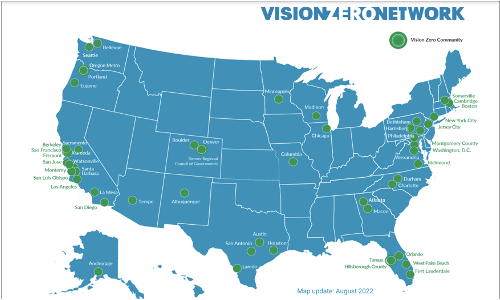
The success of Vision Zero in Sweden attracted attention from both Europe and the United States. In 2014, New York City became the first city in the U.S. to officially adopt the plan with the goal of eliminating traffic deaths by the year 2024. Since then, several cities and states across the country, including in the Bay Area, have joined the national network of cities involved in Vision Zero (Figure 1). While individual goals may differ across jurisdictions, the central principle remains the same: road deaths do not have to be an accepted risk of transportation.
However, while the framework was highly successful in Sweden, Vision Zero has been less successful in America for several reasons.
First, among the cities that have adopted the framework, police traffic enforcement is still the primary tool for communities to uphold traffic safety. What this essentially means is that by disproportionately focusing on and punishing an individual motorist’s behavior when they commit a traffic violation, the responsibility of other factors, including transportation and urban designers, tends to be overlooked.
This is not to say that enforcement has no place in Vision Zero or that motorists should not obey traffic laws, but by overly relying on police, the collaborative nature that allowed the approach to succeed in Sweden is abandoned.
The key with Vision Zero is to make traffic safety intuitive, so that enforcement is a tool, not a necessity.
Second, for the many communities that have shifted their design priorities, there is an unevenness in where the better practices are being implemented. For example, Washington, D.C. joined the Vision Zero network in 2015 with a goal to eliminate traffic deaths by 2024. However, despite commitments and projects aimed at improving road safety, traffic fatalities have increased, particularly in Black and low-income neighborhoods.
A recent study by the Urban Institute shows the stark difference in walkability—a reliable indicator of road safety for pedestrians—between the city’s neighborhoods. And in disenfranchised communities there have not been the necessary investments in traffic safety, causing community members to take these initiatives into their own hands.
When implementing Vision Zero in American cities, it is important to consider how we prioritize traffic safety while also considering existing racial and economic disparities. It is not enough for cities to simply adopt the framework, but they must tailor their solutions to account for the disproportionate harms and challenges faced by some communities.
Additionally, the success of Vision Zero may depend on cities considering the diversity of transportation infrastructure in the U.S., especially when compared to other developed nations. The success of the framework in Sweden is, in large part, due to the fact that the framework was developed for the nation’s particular traffic safety issues. When exporting the framework, adjustments are needed.
As an example, the city of Oakland has consistently dealt with a seemingly innocuous problem that has had consequences for traffic safety: potholes. Excessive potholes, especially in Black and low-income neighborhoods, means that drivers are forced to drive unsafely, creating risk for themselves and others. Thus, in a community like Oakland, a Vision Zero framework could include pothole filling as a traffic safety practice.
Another adjustment in the Bay Area can be found in San Francisco. A 2021 report found that 40% of traffic deaths in 2019 were caused by left-turning drivers hitting pedestrians in a crosswalk. Given this startling statistic, the city’s Vision Zero team began instituting left turn guide bumps as a tactic to remind drivers to make slower, safer turns.
Vision Zero has a lot of merit as a framework and stands to be most successful when tailored specially to American traffic safety concerns. Now that cities from New York to San Francisco have adopted plans to eliminate traffic fatalities and make their roads safer, there is plenty for future researchers to evaluate. How have these cities followed through on their original commitments?
Automated traffic enforcement: a tool for equitable traffic safety?
While enforcement remains a small part of the Vision Zero framework, many cities within and outside of the national network increasingly rely on automated traffic enforcement, which includes red light cameras and speed cameras, to promote traffic safety.
Within the Bay Area, three Vision Zero cities will soon have the chance to implement the technology for the first time. Assembly Bill 645, signed into law by California Governor Gavin Newsom last week, will establish a five-year pilot speed camera program in six California cities, including San Jose, San Francisco, and Oakland.
Until now, speed cameras have largely been banned in the state, and the new law is the first success in a string of legislative attempts to legalize this technology. The use of technology in traffic enforcement is a contentious topic in California. Advocates point to studies on the efficacy of automatic traffic enforcement measures, while critics cite the disproportionate impact on the already over-policed Black and Latino communities. This debate is amplified in the Bay Area due to high rates of traffic fatalities with communities looking for solutions.
Let’s walk through each side of the debate.
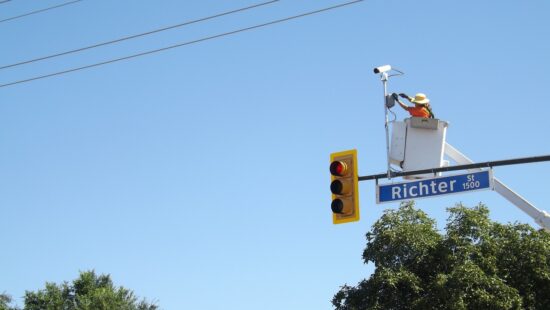
Outside California, many jurisdictions across the country currently use cameras to enforce speed limits and red-light stops. The popularity of cameras is, in part, a testament to their safety benefits.
Research shows that speed and red-light cameras reduce collisions, are cost-effective, and reduce motorist speed in their vicinity.
Beyond these benefits, supporters also argue that the technology also has the potential to make traffic safety and enforcement more equitable. The devices could curtail interactions between police and civilians, reducing the chance of an interaction unnecessarily escalating while still enforcing traffic laws.
Opponents argue that cameras are more trouble than they are worth for two particular reasons.
First, many cite the privacy issues that could potentially be associated with the cameras. In order to ticket drivers, the devices use automatic license plate reader (ALPR) technology to read license plates and find drivers via DMV records. In 2020, the California State Auditor found that of the four agencies in the state that used ALPRs, none had an ALPR usage and privacy policy that met legally mandated requirements.
For many, this presents a real issue. How can communities ensure that cameras will be used properly and safely? AB 645 does include a provision that ALPR usage must abide by state privacy mandates. Additionally, if there is no speed violation, all information collected is destroyed within five business days. But whether further issues arise in implementation remains to be seen.
Second, while facially race- and class-neutral, automated traffic enforcement does have the ability to disproportionately harm particular groups. When the devices are introduced to a jurisdiction, the cameras are typically placed in the locations where traffic stops, accidents, and fatalities occur the most frequently. As discussed previously, traffic safety and enforcement is uneven, meaning that when implemented, the cameras are typically concentrated in low-income Black, and Latino communities.
What this looks like in practice can be alarming. In Washington, D.C., which has one of highest numbers of speed cameras in the country, a recent study showed that a driver in a predominantly Black neighborhoods is 17 times more likely to be ticketed by the cameras than when driving in predominantly white neighborhoods. Similar racially disparate impacts of speed cameras were also observed in Chicago, with predominantly Black neighborhoods amassing more than half a billion dollars in fines over 15 years.
When you consider the fact that fines generate revenues, what this looks like to many is a chance to make money off the most disenfranchised within a city. For technology in traffic safety to work equitably, it will take more than race-blind cameras, but rather, a policy approach that considers disproportionate outcomes.
The pilot program in California represents a new way to cautiously weigh the benefits of automated traffic enforcement with the negatives. Hopefully, if instituted with a race-conscious approach, the program can improve traffic safety without unequally impacting marginalized communities.
Moving forward
What is the ultimate goal of traffic safety? To keep roads safe in order to keep people safe from harm.
Vision Zero is one way to achieve this goal. If implemented successfully, traffic fatalities could become a thing of the past. However, our research has shown us that years following a city’s commitment to Vision Zero or implementation of automated traffic enforcement tools, communities are still unsuccessful in making roads safe, especially in a manner that reduces the harms facing vulnerable populations.
While Vision Zero and traffic cameras represent one way to make roads safe from harm, they are not the only solutions. For too long, traffic safety and enforcement has lacked innovation. This is a policy arena that sits at the intersection of policing, racial equity, health, and technology, especially in the Bay Area.
The solutions discussed in this essay and series represent a start, but for truly safe roads, communities require more discussion, research, and unique solutions for traffic safety.

Source link